

August 31, 2026
1、 Technological leap: Spring ejector pin CNC precision machining enters a new stage empowered by AI
(1) The paradigm revolution from “numerical control programming” to “AI self optimization”
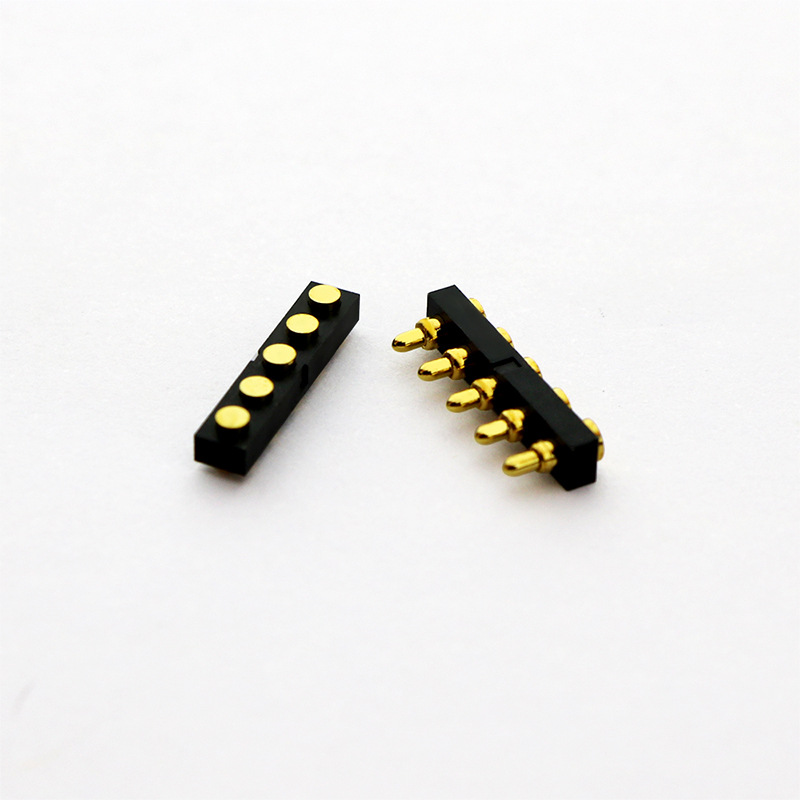
The Pogo Pin, as a precision spring type conductive connector, consists of three core components: the needle head, needle tube, and spring. Its manufacturing has long relied on high-precision CNC machines, precision automatic lathes and other CNC equipment, with extremely high machining accuracy requirements – the clearance between the needle and the needle tube needs to be controlled at the micrometer level, and the internal spring wire diameter can be as fine as 0.02 to 0.3 millimeters.
In 2026, this traditional precision manufacturing field is undergoing a profound transformation. Artificial intelligence technology has fully entered the factory workshop from concept verification, becoming a normalized capability for CNC machining. In the CNC machining scenario of spring top pins, AI driven adaptive machining is replacing the traditional fixed parameter programming mode – the machine tool’s built-in sensors monitor vibration, load, and temperature changes in real time, and AI algorithms automatically adjust feed rate, spindle speed, and tool path based on this. The new generation CNC 500i+Physical AI system launched by Fanuc has achieved functions such as AI thermal displacement compensation, AI servo optimization, and digital twin virtual debugging. The Huazhong 10 intelligent CNC system of Huazhong CNC integrates AI dedicated chips, supporting voice interaction, natural language programming, intelligent generation of G-code, and adaptive optimization of process parameters. This’ AI native ‘processing method makes every cutting process more intelligent.
(2) Digital twins and predictive maintenance: from ‘passive response’ to ‘proactive prevention’
Digital twin technology is becoming the production backbone of spring top needle CNC machining. The digital twin of 2026 has surpassed static CAD visualization, with real-time machining data continuously flowing back into simulation models to optimize their accuracy, making each production cycle smarter than the previous one. The Siemens SINUMERIK ONE system has integrated digital twin architecture throughout the entire process from CAD, CAM to production. In the actual production of spring top pins, virtual debugging, collision detection, and kinematic verification can be completed before the first piece cutting, greatly reducing clamping errors and delivery cycles.
Predictive maintenance has also changed the operational logic of factory workshops. Sensors embedded in CNC equipment monitor vibration, temperature, and spindle load in real-time, and AI algorithms analyze data to predict bearing failure or tool life endpoint in advance. McKinsey data shows that AI driven predictive maintenance can reduce machine downtime by up to 50% and maintenance costs by 40%. For products like spring top pins that require high precision consistency, this means more stable quality output and more reliable delivery cycles.
(3) Breakthrough in Composite Processing and Sub micron Precision Technology
The 2026 ITES Shenzhen Industrial Exhibition shows that metal processing machine tools are showing four clear trends: composite processing reduces the single piece cycle by 50% to 60%, sub micron precision (less than 1 micron) becomes standard, and AI thermal compensation and digital twin reduce manual intervention by more than 30%. In the manufacturing of spring top needles, the introduction of high-end equipment such as five axis linkage and nine axis five linkage integrated turning and milling composite enables multi face turning and milling of needles and needle tubes to be completed in one clamping. The GA-FA320 five axis vertical machining center launched by Gree adopts a fully direct drive five axis cradle turntable, with a repeat positioning accuracy of 0.006 millimeters. The Beijing Jingdiao JDMR400MT high-speed machining center is equipped with a machine measurement system that can detect the status of workpieces, cutting tools, and machine tools in real time and correct deviations. These technological breakthroughs provide the equipment foundation for the spring ejector pin to leap from micrometer level accuracy to sub micrometer level accuracy.
2、 Industry Wave: AI Intelligent Robots Enter a New Cycle of Large Scale Implementation
(1) Policy driven and continuous expansion of industrial scale
2026 is recognized by the industry as the “first year of mass production” for humanoid robots. The Ministry of Industry and Information Technology has explicitly listed intelligent robots as one of the key emerging pillar industries to be developed during the 15th Five Year Plan period. In June, the Ministry of Industry and Information Technology and the State owned Assets Supervision and Administration Commission of the State Council jointly issued the “Notice on Jointly Carrying out the Special Action of Realistic Training for Humanoid Robots and Embodied Intelligence in 2026″, which clearly stated that by the end of 2026, a large-scale landing capacity of 10000 units would be formed. The Ministry of Commerce and eight other departments have also issued opinions supporting the development of humanoid robots with multimodal perception and scene adaptation capabilities.
Industry data confirms the accelerating effect of policies. By 2025, the operating revenue of enterprises above a certain scale in China’s robotics industry will exceed 300 billion yuan, with an average annual growth rate of over 20% in the past five years; In the first half of 2026, it will reach 165.5 billion yuan, a year-on-year increase of 24.5%. In the first quarter of 2026, the export of humanoid robots increased by 210% year-on-year, and Morgan Stanley raised its expected shipment volume of humanoid robots in China this year to 50000 units. The White Paper on the Development of Intelligent Robot Industry in 2026 released by PwC points out that China’s intelligent robot industry has fully entered a transformation cycle from technology pilot and scenario verification to large-scale implementation, commercial popularization, and industry wide penetration.
(2) Explosive demand for connectors from industrial robotic arms to humanoid robots
The rapid iteration of AI intelligent robots is driving a massive demand for precision connectors. In the field of industrial robots, the connection between the end effector of the robotic arm and the tool quick change device commonly uses Pogo Pin modules, which can integrate 30 to 50 contacts in a single group, support EtherCAT protocol signal transmission and maximum 30A power supply, and have a plug-in life of over 100000 times. During the continuous high-intensity operation of industrial robots, the spring top pin ensures stable power supply with its strong current carrying capacity.
The rise of humanoid robots has further amplified this demand. According to industry statistics, the global market size of modular connectors for humanoid robots will reach 1.46 billion US dollars by 2025, an increase of 72.3% compared to 2024. McKinsey’s 2026 supply chain analysis shows that articulated actuator systems account for 40% to 60% of the total material cost of humanoid robots. 2026 is the first year of mass production for humanoid robots, with a single robot’s precision elastic components valued at 800 to 1200 yuan. In the future, the shipment of millions of units will bring an incremental market of hundreds of millions. Scenes such as humanoid robot joint connectors, sensor wiring harnesses, and dexterous hand contacts all require a large number of miniature spring top pins and precision probe springs.
(3) AI computing power demand drives upgrade of connectivity solutions
The exponential growth in demand for AI computing power is also driving technological iterations in connectivity solutions. The new generation of AI server architectures such as NVIDIA GB200 and Rubin Ultra are driving the transition of connectivity solutions from traditional stamping springs to Micro Pogo Pins – connecting tens of thousands of pins in a single cabinet. Micro Pogo Pin, as a miniaturized upgrade product of traditional Pogo Pin, is developed specifically for ultra small, high-density, and ultra-thin spaces. In the field of AI robots, precision connectors are upgrading from “auxiliary accessories” to “core infrastructure”.
3、 Fusion Innovation: Spring Top Needle CNC Technology Empowers AI Robots with the ‘Body of Wisdom’
(1) Miniaturization and high density: a key link in robot weight reduction
In the field of AI robots, ‘every gram of weight affects energy consumption and endurance’. The spring top pin, with its compact size and design, naturally meets the lightweight requirements of robots. The industry standard for the outer diameter of Micro Pogo Pin needles is less than 0.8 millimeters. In limited spaces such as joint modules, dexterous hands, and sensors of humanoid robots, micro spring top pins can achieve stable connections at extremely small sizes, freeing up space for robots to carry more sensors, batteries, or computing chips. Leading enterprises such as Changying Precision have achieved large-scale delivery of precision components for humanoid robots – delivering 689000 robot components by 2025 and shipping over 380000 components in the first four months of 2026.
(2) Vibration resistance and high lifespan: reliability guarantee for robot “operation”
AI robots, especially humanoid robots and industrial robotic arms, operate under complex working conditions of high-speed motion, high-frequency vibration, and frequent insertion and extraction, placing strict requirements on the reliability of connectors. The long-life Pogo Pin spring top pin adopts high-strength alloy material and special spring structure design, which can not only maintain stable connection in the vibration environment generated by high-speed robot movement, but also ensure the accuracy of signal transmission. In the field of industrial robots, the insertion and removal life of Pogo Pin modules is over 100000 times, far exceeding the upper limit of 50000 times for traditional connectors, meeting the 24-hour uninterrupted operation requirements of production lines. For high vibration and high impact application scenarios, connector manufacturers have also launched products specifically designed for robot joint modules, achieving integrated transmission of power and signals in compact spaces.
(3) High current and high-speed signal: dual support of robot’s “power” and “intelligence”
The requirements for connectors in AI robots have evolved from a single signal transmission to a dual requirement of “high current power supply+high-speed signal”. The Pogo Pin spring-loaded top pin independently developed by Shuangmeng Electronics is tailor-made for industrial robots and supports high current transmission up to 30A. In the magnetic attraction connection scheme, neodymium iron boron permanent magnets are combined with Pogo Pin spring top pins, relying on magnetic force to achieve automatic adsorption and alignment of male and female ends, with a magnetic force of up to 2.0kgf. The MiniMix hybrid power and signal connector, launched by Molex in 2026, integrates up to 15.0A power transmission and 1Gbps Ethernet communication into a single interface, specifically designed for humanoid robots and autonomous mobile robots. Laimu Corporation will also translate and reuse the automotive grade technology system accumulated over 20 years of deep cultivation in automotive precision connections to new tracks such as humanoid robots. These technological innovations have evolved the spring top pin from a simple “conductive contact” to a “neural node” that combines power transmission and intelligent communication capabilities.
(4) Customization and Flexible Matching: Manufacturing Bases for Robot Diversity
The application scenarios of AI robots are highly differentiated – from industrial manufacturing to home services, from warehousing and logistics to medical care – and different scenarios have different requirements for the size, material, current, and signal of connectors. Spring pin connector manufacturers can provide customized research and technical support for different robot structures with the high flexibility of CNC precision machining. Dongguan Shuangmeng Electronics has launched multiple high reliability spring top pin connectors for weed control robots, swimming pool robots, industrial robots, and other scenarios, supporting personalized customization. The Micro Pogo series launched by Toplink provides reliable solutions for high-density and high-speed interconnects. This “flexible manufacturing” capability is an important support for the AI robot industry to move from “uniformity” to “thousands of machines and thousands of faces”.
4、 Outlook: The ‘bidirectional rush’ of precision manufacturing and intelligent robots
(1) The synergistic effect of the industrial chain is accelerating its formation
With intelligent robots listed as an emerging pillar industry during the 15th Five Year Plan period, the spring top needle CNC precision machining industry is ushering in unprecedented market opportunities. The 2026 World Robot Conference, with the theme of “Human robot symbiosis, production and demand integration”, has attracted more than 300 companies to participate. From the core components selected as one of the “Top Ten Innovative Achievements of Central Enterprises in Robotics” to space embodied intelligent robots, the upstream and downstream of the industrial chain are accelerating their aggregation. At the CCMT2026 exhibition, major manufacturers concentrated on creating exclusive processing display areas for robot components. The five axis machining center can accurately complete the mass production and processing of core precision components such as humanoid robot joint shells and torso structural parts. The Shenzhen Artificial Intelligence Industry Association released the group standard “Technical Requirements for Wiring Harness Components for Tailored Intelligent Robots” in April 2026, filling the gap in hardware standards.
(2) The deep integration of AI and precision manufacturing continues to deepen
By 2026, artificial intelligence technology has become a normalized and standardized capability for industrial mother machines, fully integrated into the entire business process of intelligent control, precision machining, and equipment operation and maintenance of five axis machine tools. In the CNC machining of spring top pins, Generative Industrial Manufacturing Technology (GenCAM) relies on industrial large-scale models to achieve automatic conversion from 3D drawings of parts to CNC tool paths and G-codes in seconds, improving programming efficiency by more than 80%. Industrial mother machines and intelligent robots are co evolving to achieve rhythm synchronization and spatial collaboration. This deep integration of “AI+precision manufacturing” is reshaping every aspect of the spring ejector pin from design to delivery.
Post time: Aug-31-2026